Most hypermiles, ecomodders, and fuel-economy fans are familiar with using a block heater to improve fuel economy in a gasoline vehicle. However, drivers of electric vehicles should also know that warming your batteries in the winter can give greatly improved EV performance.
In general, my cheap-o electric car (running on used batteries) has had a range of about 20 miles in the summer, but could be as low at TEN miles in the winter!
While there is snow, increased rolling resistance, thicker transmission fluid, etc in the winter, the MAIN difference is battery temperature.
Many battery types just can't give out as much power when they are cold. A simple example of that is trying to start a gas car on a cold winter day. The starter (powered by the battery) just doesn't crank as fast and hard.
So, to keep our cold-climate EVs in top notch performance for the winter, here's a few things to try:
USE YOUR GARAGE:
If you have a garage, use it! Even though my garage is not attached to the house, isn't heated or insulated, it still keeps the wind, rain, and snow off the car. What little heat is in the car gets retained a bit better. If you have a heated garage, that's probably the ultimate way to get better winter EV performance.
OTHER SHELTER:
If you don't have a garage, at least try to park out of wind, perhaps next to a tree, which in real-world testing have been shown to act as heat storage and help prevent frost formation on the car's windows. (But watch out for pine sap!)
INSULATE YOUR BATTERIES:
Batteries will be much happier if they are wrapped in a cozy blanket. If batteries are exposed to the outside world (such as under the hood) heat can also be lost to wind. Any insulation should be water-resistant and non-conductive - using foil-faced foam is a bad idea - but using pink builder's foam works great.
WARM YOUR BATTERIES:
Find some way to get a little heat into your batteries. The best way is with something in direct contact with the batteries, either under them, or on the sides. It will need to have some sort of automatic temperature control, to prevent overheating.
Waterbed mattress heaters, electric blankets, and water-pipe freeze prevention tape all have automatic temperature controls, and can easily be repurposed to warm batteries. Make sure to not set batteries directly on heating elements. Many heaters can be easily wrecked that way.
IF YOU ARE HAPPY, YOUR BATTERIES ARE HAPPY:
While I don't mind wearing a heavy coat, hat, and gloves in the winter, it is nice to be just a bit cozier than that in my car. Last winter, I experimented with an oil-filled electric radiator space heater. I simply put it in the car (behind the passenger seat) and ran an extension cord out the window. That was plugged into a timer going to the wall. The heater came on automatically in the morning, and heated the inside of the car for about 45 minutes before I left for work. I would unplug the heater, and drive off. The heater would stay warm for about 10 minutes after that. (In my gas car, it takes 10 minutes for the engine to warm up in the winter!)
The unexpected side effect of warming the inside of the car, was that it also warmed the batteries! By trying to make myself more comfortable, I also improved the range of my battery pack!
CHARGING = HEAT:
Another trick is based on the fact that running electricity through the batteries (either discharging OR charging) warms the batteries.
Set the car's charger up on a timer so that the charge is just finishing up when you will next use the car. The batteries will be a little warmer than they would be if they simply sat charged all night. Also, opportunity charge any chance you get. Even short charges can increase your range more from the heat than from the electricity to the batteries.
I hope these tips help keep your car happy and healthy this winter! If you have any other winter electric car tips, please post them below!
Showing posts with label winter. Show all posts
Showing posts with label winter. Show all posts
Friday, October 23, 2009


Sunday, October 18, 2009
Cycles and Winterizing
Sunday was another EV Build Day of the Milwaukee Electric Car Club.
It turned out that we had great weather. Sunny, and about as warm as can be expected for October in Wisconsin.
Of course, it also means that some of us are thinking about what we need to do for our EVs for the winter.
I have already noticed my battery voltage dropping extra quick in my homebuilt Electric Geo Metro. Lead-Acid batteries just don't like being cold, as most drivers have noticed trying to crank their starters in the winter.
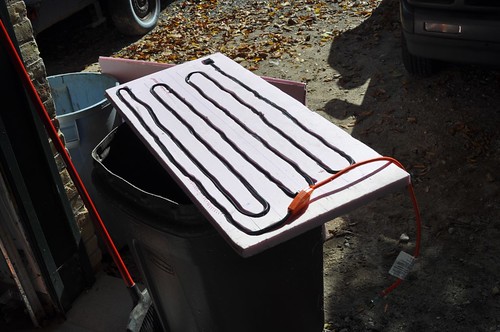
So, I spent a little time with a few parts I had kicking around from the home improvement store. I measured my battery box, and cut a one-inch-thick chunk of pink foam insulation to that size. Then I used a router to carve a serpentine path in the foam, so that I could push heat tape down into it. This is a product used to wrap pipes that could otherwise freeze, or put on the edge of your roof to keep ice from forming. It has a thermostat built right in to it.
One of our other members was also working on trying to add some insulation to the batteries in his electric S-10 pickup truck. Unfortunately, there wasn't much room between the batteries and supports to squeeze insulation in there, so he went on to work on his Pak-Trakker instead.
The real fun of the day was working on Chris' motorcycle.
Already, the motor is mounted in with a custom Mr. Speed adapter to the driveshaft of the cycle. That's right! It's a shaft cycle! You don't see too many of those in the EV flavor!
Todays work was figuring where to put the batteries. Because the frame itself is fairly large, it sure makes the job of battery location easier. Still, it's never easy to fit big square batteries into curved spaces. Chris and Rich welded in the first battery tray directly next to motor. Another battery could fit in FRONT of the motor, but only if it were turned and stuck out a bit funny.
Instead, we used a bottle jack to spread the front down tubes just a tad, so the battery would fit cross-wise. Then the second battery tray was trimmed to fit (Chris with the grinder again!) so it could be welded in place.
The cycle has been a really fun project to work on, with pretty much all the parts donated, and all of us doing what we can, when we can. I can't wait until we work on the body for the cycle. I'm sure it will get pretty crazy with LED back-lighting and interesting shapes.
Subscribe to:
Posts (Atom)

 Posts

